
Imagine Before You Act: World Models — Part 6: Do Language Models Have World Models?
November 21, 2026 · 9 min read · World Models, Interpretability, Large Language Models, Machine Learning
The world models in Parts 1–5 were built on purpose: we told each one to predict the next state, frame or embedding. This part is about the third meaning of "world model" from Part 0: the implicit kind. Does a model trained on something else, such as predicting the next word, build an internal picture of the world anyway, because it helps with the prediction?
The question matters most for large language models. They are trained only to predict text. Critics say they learn "surface statistics": which words tend to follow which. Others argue that predicting text well enough requires modelling the things the text is about. Arguing in general goes nowhere, so researchers built a small, fully controlled test case: Othello-GPT (Li et al., 2023).
By the end you'll know:
- how Othello-GPT is set up, and why Othello is a good test,
- how linear probes find the board inside it, and why the encoding you probe for matters,
- how editing the internal board changes the model's moves: evidence that the model uses it,
- what this does and doesn't tell us about large language models.
This part uses tools from the interpretability series: probes from Part 2 and interventions from Part 6 there.
1. Othello-GPT#
Othello is a two-player board game on an 8×8 grid. Players take turns placing a stone; any opponent stones trapped in a straight line between the new stone and another of the player's stones flip to the player's colour. A move is only legal if it flips at least one stone. If a player has no legal move, they pass.
Othello is a good test because:
- the board state is hidden from a model that only sees the list of moves played so far, so it has to be worked out;
- working it out is hard: one move can flip stones in up to eight directions, far from where it was played;
- legal moves depend on the whole board, so predicting them well from the move list alone is very hard without tracking the board.
The setup:
- Data. Games of random legal moves, generated by a simple engine. Each game is just a sequence of up to 60 square names, like
d3, c5, f6, .... The model never sees a board. - Model. A GPT-style transformer, trained only to predict the next move.
- Test. Is the model's top prediction a legal move? Since moves are random, the best a model can do is spread its probability over the legal moves, and to know which moves are legal, it needs the board.
Our version: an 8-layer transformer with a 512-dimensional residual stream (25 million parameters), trained on 1.5 million random games. On one GPU, generating the games and training took about 50 minutes. The original used 20 million games, so ours is a small copy.
Result: on games it has never seen, the model's top prediction is a legal move 98.9% of the time. (The original, with 13 times more data, makes an illegal move only about once in 10,000.) For comparison, a typical position has around 10 legal moves out of 60 squares, and which ones are legal changes with every move.
2. Probing for the board#
If the model tracks the board, the information should be readable from its residual stream, the running sum of every layer's output. We train a linear probe for each of the 64 squares: at a given layer and move, a linear map from the 512-dimensional activation to three classes for that square. We train on 2,500 games and test on 500 others.
The question is which three classes. The obvious choice is black / white / empty. Li et al. found that linear probes with these labels worked poorly, and needed nonlinear probes. Neel Nanda then found the fix (2023): label each square relative to the player, as mine / theirs / empty. The model plays both sides, so it seems to care whether a stone belongs to the player who just moved, not what colour it is.
Here is the probe accuracy at each layer, measured on occupied squares only (is this stone mine or theirs?). Empty squares are left out because they are too easy: a square is empty exactly when its name hasn't appeared in the move list.
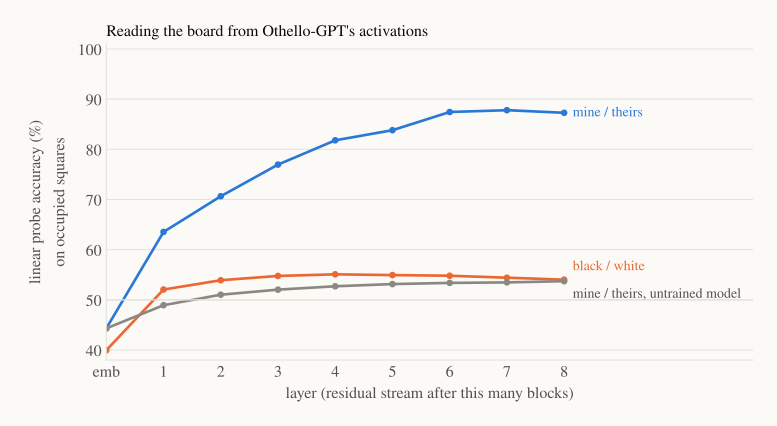
- With mine / theirs labels, accuracy climbs from 64% after the first block to 88% after the seventh. The board is built up gradually, layer by layer, and it is linearly readable.
- With black / white labels, the same kind of probe never gets above 55%, barely better than a coin flip. The information is identical, since the colours and the mover determine each other. Only the encoding differs. A probe finds what the model represents, in the form the model represents it.
- The grey line is the control from the interpretability series: the same probe on a randomly initialized, untrained transformer reaches only 54%. So the probe isn't working the board out by itself from the move list. The trained model did that work.
88% is well below the 99% reported for the original, much larger training run. Our model's board is imperfect, which fits its 98.9% (not 99.99%) legal-move rate. Here is one position, with the true board next to what the layer-7 probes read:
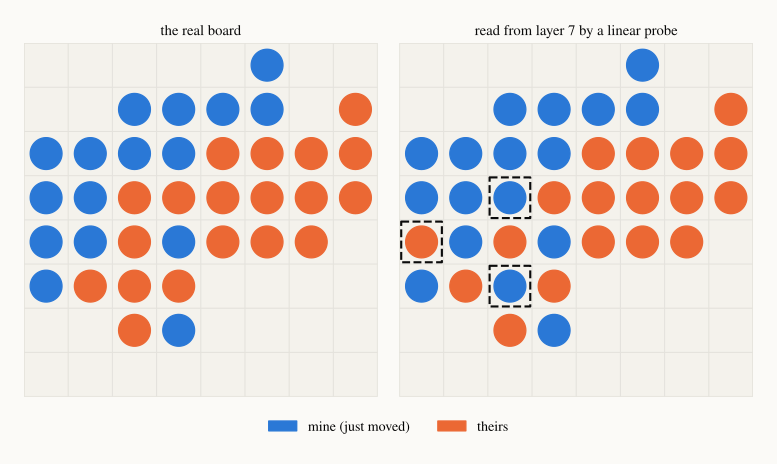
The probes get 61 of 64 squares right. The three mistakes are all stones assigned to the wrong player.
3. Editing the board inside the model#
A probe shows the board is there. It doesn't show the model uses it. Maybe the board is a side effect, and the model predicts moves some other way. (This is the "correlate vs cause" rung from the interpretability series.)
The test: change the board inside the model and see whether the predicted moves change to match. If the model reads its moves off its internal board, then flipping one stone in that internal board should change the predicted legal moves exactly as flipping it on a real board would.
The probe for a square gives us two directions in activation space: one for "mine" and one for "theirs". Their difference points from "theirs" to "mine". To flip a stone, we take the activation after block 6 at the last move, find its coordinate along , and push it to the other side: a "mine" stone now reads as "theirs", and vice versa. Everything else in the activation is left unchanged. Then we let the remaining two blocks run and look at the predicted moves.
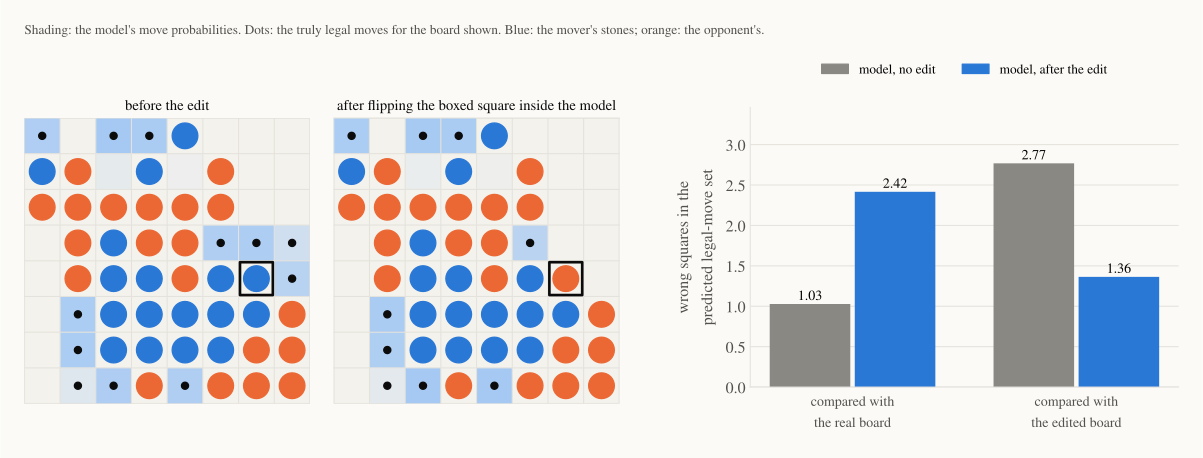
In the example, the boxed stone belongs to the player who just moved. On the real board (left) there are 12 legal moves, and the model puts its probability on exactly those squares (dots). After we flip that one square inside the model (middle), three of those moves, the ones next to the flipped stone, are no longer legal on the edited board, and the model stops predicting them. Nothing in the input changed. The move list is the same. Only the model's internal board was edited.
To measure this, we took 500 random positions and, in each, flipped one stone chosen so that the legal moves change. We compare the model's predicted move set with the legal moves of the real board and of the edited board, and count the squares where they differ:
| Compared with the real board | Compared with the edited board | |
|---|---|---|
| Model, no edit | 1.03 wrong squares | 2.77 |
| Model, after the edit | 2.42 | 1.36 |
After the edit, the model's moves fit the edited board (1.36 wrong squares) much better than the real one (2.42). They were closer to the edited board in 53% of cases, tied in 31%, and closer to the real board in 15%. Before the edit, they were closer to the edited board in only 5%.
The edit isn't perfect. 1.36 is a little worse than the unedited model's 1.03 on real boards, and the model got the edited board's moves exactly right in 48% of cases (against 61% for real boards without an edit). A one-direction edit at one layer is a blunt tool, and the layer and strength were chosen on a separate set of 300 cases. Still, the direction of the effect is clear, and it's a causal one: the model reads its moves off an internal board, and changing that board changes the moves.
4. So, do language models have world models?#
Othello-GPT shows that next-token prediction alone can produce an internal model of a hidden world state: one that is linearly readable, and that the model uses to decide what comes next. That answers the strong form of the "surface statistics" objection, in this setting.
What it doesn't show:
- Language is not Othello. The board is a small, exact, fully determined state. The "world" behind text is vast, vague and partly unknowable. Probing studies on real LLMs have found linear representations of things like spatial and temporal position (Gurnee and Tegmark, 2023), and of truth or falsehood of statements, but these are partial and noisy, nothing like a full board.
- Representations can be incomplete. Vafa et al. (2024) trained transformers on taxi rides in New York and found models that predicted the next turn almost perfectly, yet whose implied street map was incoherent, full of impossible streets. Good next-step prediction did not guarantee a coherent world model. Their Othello models trained on synthetic data did better than those trained on championship games.
- Training data matters. Othello-GPT learns the board from millions of random games, which cover the space evenly. Trained on expert games only, models learn a less complete board: experts never play most of the positions.
The fair summary: "Do LLMs have world models?" is not a yes/no question. Models can build internal world models when it helps prediction, but how complete and coherent those models are has to be measured, model by model, with probes and interventions like these.
Recap#
- Othello-GPT is a transformer trained only on move sequences of random legal Othello games. It never sees a board.
- Its top predicted move is legal 98.9% of the time, which is hard to do without tracking the board.
- Linear probes read the board from its residual stream (88% of occupied squares at layer 7), but only when squares are labelled mine / theirs. With black / white labels they stay near 55%, the same as on an untrained model: the model represents the board from the mover's point of view.
- Editing one square of the internal board moves the predicted legal moves towards the edited board (1.36 wrong squares against 2.42 for the real board): the model uses its board.
- This shows that next-token prediction can produce an implicit world model. Whether a given LLM has a complete, coherent one is an empirical question.
Next up — Part 7: Evaluating World Models, and a Checklist. Across the series we measured models in many ways: one-step error, rollouts, probes, planning success. Which of these actually tell you a world model is good enough? We test that directly, and end with a checklist.